How Can a Neutron Star Not Be a Pulsar
Pulsars are known for their extreme conditions. The Crab Nebula Supernova Remnant has a Pulsar in the centre.
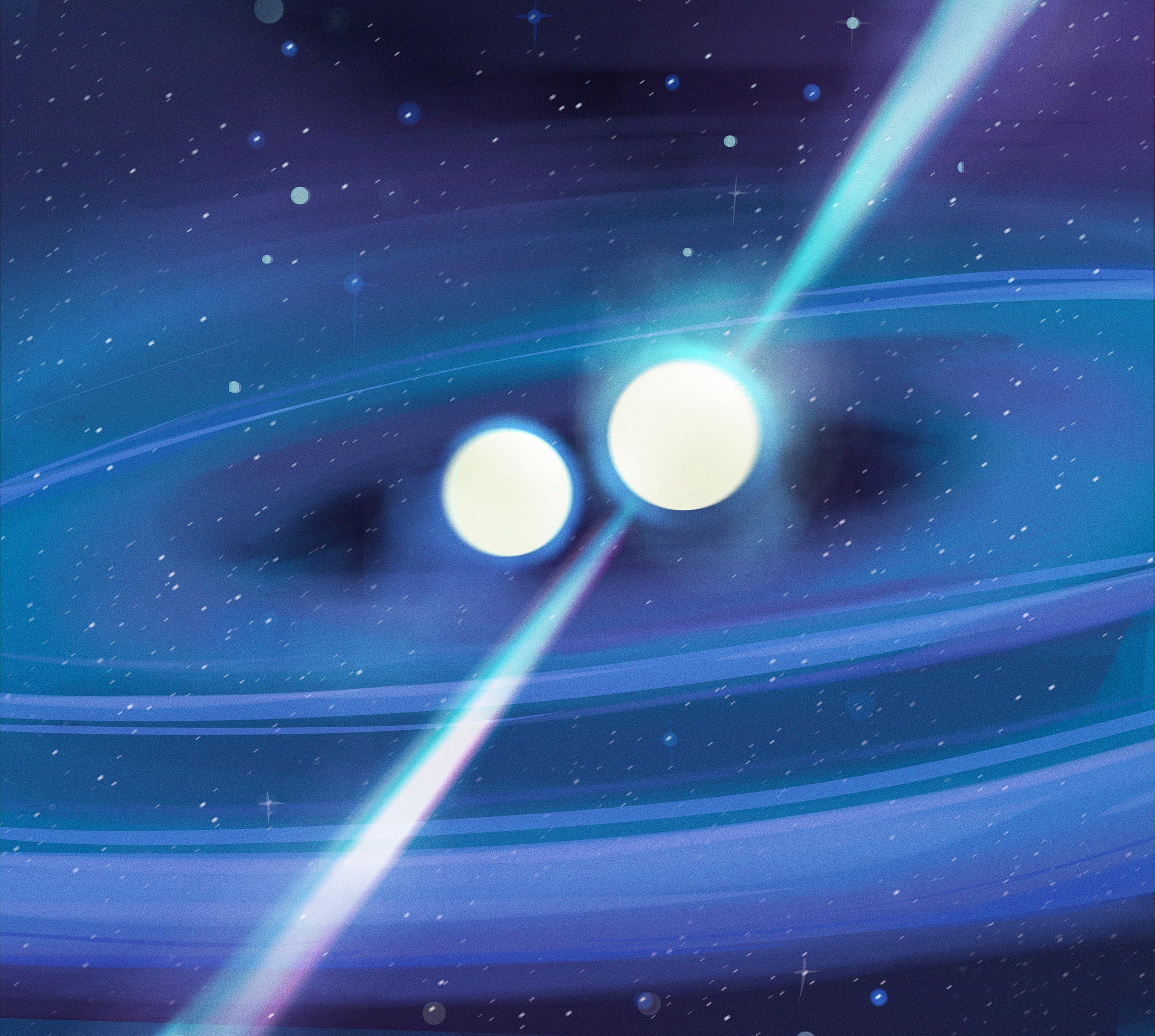
Vital Clues To Unsolved Mysteries In Astrophysics Including Expansion Of The Universe From Colliding Neutron Stars
However under certain conditions they can be easily observed.

. Magnetars are a type of pulsar and pulsars are a type of neutron star. This radiation can be observed only when a beam of emission is pointing toward Earth and is responsible for the pulsed appearance of emission. But even many young pulsars are invisible to us with radio telescopes because of their narrow lighthouse beams.
Many neutron stars are likely undetectable because they simply do not emit enough radiation. It is theoretically possible that habitable planets exist around pulsars spinning neutron stars that emit short quick pulses of radiation. Couple that with the intense magnetic fields of a magnetar and youre in for some astonishing behavior.
A neutron star alone couldnt become a pulsar. Neutron stars are detected from their electromagnetic radiationNeutron stars are usually observed to pulse radio waves and other electromagnetic radiation and neutron stars observed with pulses are called pulsars. Can A Neutron Star Become a Pulsar.
A neutron star has a crust much like Earth likely coated in a layer of iron nuclei. A pulsar is a highly magnetized rotating neutron star that emits beams of electromagnetic radiation out of its magnetic poles. Whereas a 1000-degree Fahrenheit charcoal fire glows red young neutron star surfaces are over a million degrees and glow in X-rays.
Pulsars are a result of stars that have gone supernova leaving behind a rapidly spinning neutron star. For another thing neutron stars dont just spin fast they travel fast. Not only are neutron stars tremendously dense they are also incredibly hot.
For one thing not all neutron stars have radiation beams that sweep directly over Earth. However celestial collisions can create all sorts of interesting results. Neutron stars in binaries are extremely luminous but only in X-rays which at the time were undetectable.
The following are the corresponding values for a neutron star. If we ever detect the gravitational waves from such spinning stars most will not have a detectable electromagnetic pulsar signal - we should be so lucky to define both for a single object. A neutron star is approximately 20 miles in diameter.
Neutron stars emit high-energy beams at its North and South magnetic poles which is usually made from material from a companion star. Neutron stars can only be easily detected in certain instances such as if they are a pulsar or part of a binary system - Wikipedia If the pulsar is radiating gamma rays more isotropically but still varying with phase as in the Manchester charts then these could be detected. So all Pulsars are Neutron stars but not all Neutron stars are Pulsars.
A neutron star weighs approximately 281030 kilograms. So a neutron star found in the center of a supernova remnant wouldnt necessarily be a pulsar. A special kind of neutron star known as a pulsar emits periodicor repeatingbursts of radio waves X-rays and.
Anything higher will create a black hole. A pulsar is a magnetised. This produces a very precise interval.
You can buy Universe Sandbox 2 game here. So all magnetars are neutron stars but some neutron stars are not pulsars and some pulsars are not magnetars. A neutron star the ultra-dense remains of a once vast star is believed to be in a fiercely tight orbit around a pulsar.
Pulsars radiation is thought to be caused by particle acceleration near their magnetic poles which need not be aligned with the rotational axis of the neutron star. 14 times the mass of the Sun Therefore to imagine a neutron star ns one can imagine all the material that comprises the Sun in a 432000 mile radius sphere. Its more likely that a collision would force a neutron star into a secondary collapse to become a black hole.
And even among the pulsars there are only 12 of them that we can actually see. Surprisingly first discovered by accident via pulsed radio emission- pulsars by Jocelyn Bell in 1967. If these beams are pointed at Earth as the Neutron star rotates they seem to pulse.
The frequencies of the two may be related however since both are linked to the rotation of the neutron star. These neutron stars are not called pulsars. Obvious that isolated neutron stars would be very faint and hard to detect.
A pulsar spins on its axis similar to the Earth only pulsars can spin around in. If we were able to find a neutron star that wasnt spinning or had a very low angular momentum the magnetic field would be smaller or non-existent and the infalling matter wouldnt necessarily fall on any preferred spot. Neutron stars are very dense and have short regular rotational periods.
Earths magnetic field changes over time with the north and south poles meandering and occasionally flipping and the same thing happens on a magnetar. If this were the case then it is plausible that the neutron star would not have a beam like a pulsar. Each is a fast-spinning neutron star the collapsed core of a massive star that has gone supernova at the end of its lifeIt is theoretically possible that habitable planetshabitable planetsBased on.
Httpamznto2yJqwU6Hello and welcome to What Da MathIn this video we will talk about Pulsars and their habitab. If the neutron stars beams are not oriented towards Earth we will not detect a pulsar. A star can only become a Neutron Star when the solar mass of the star is between 1 and 3 solar masses.
Without much available energy to power emissions at various wavelengths they have faded to near invisibility. Most neutron stars are billions of years old which means they have plenty of time to cool and spin down. We mostly cant see ordinary neutron stars.
However neutron stars that arent pulsars are very difficult to observe. Many theories predict that the more massive neutron star should have a radius that is smaller. As rotational energy is extracted we can obtain an estimate of the neutron-star magnetic field from the measurement of the rate of change in the spin.
The neutron star produces the phenomenon known as a pulsar which is a beam of. Neutron stars can not only be found in Pulsars but also in Magnetars and at the centres of supernova remnants. Neutron star - magnetic field II If a spinning neutron star has a dipole magnetic field and the dipole axis and spin axis are not aligned to each other it will emit electro-magnetic radiation.
A handful of neutron stars have been found sitting at the centers of supernova remnants quietly emitting X-rays. More often though neutron stars are found spinning wildly with extreme magnetic fields. That it is not tells us that in some sense the matter inside neutron stars is.
Pulsars And The Discovery Of Neutron Stars Astronomy
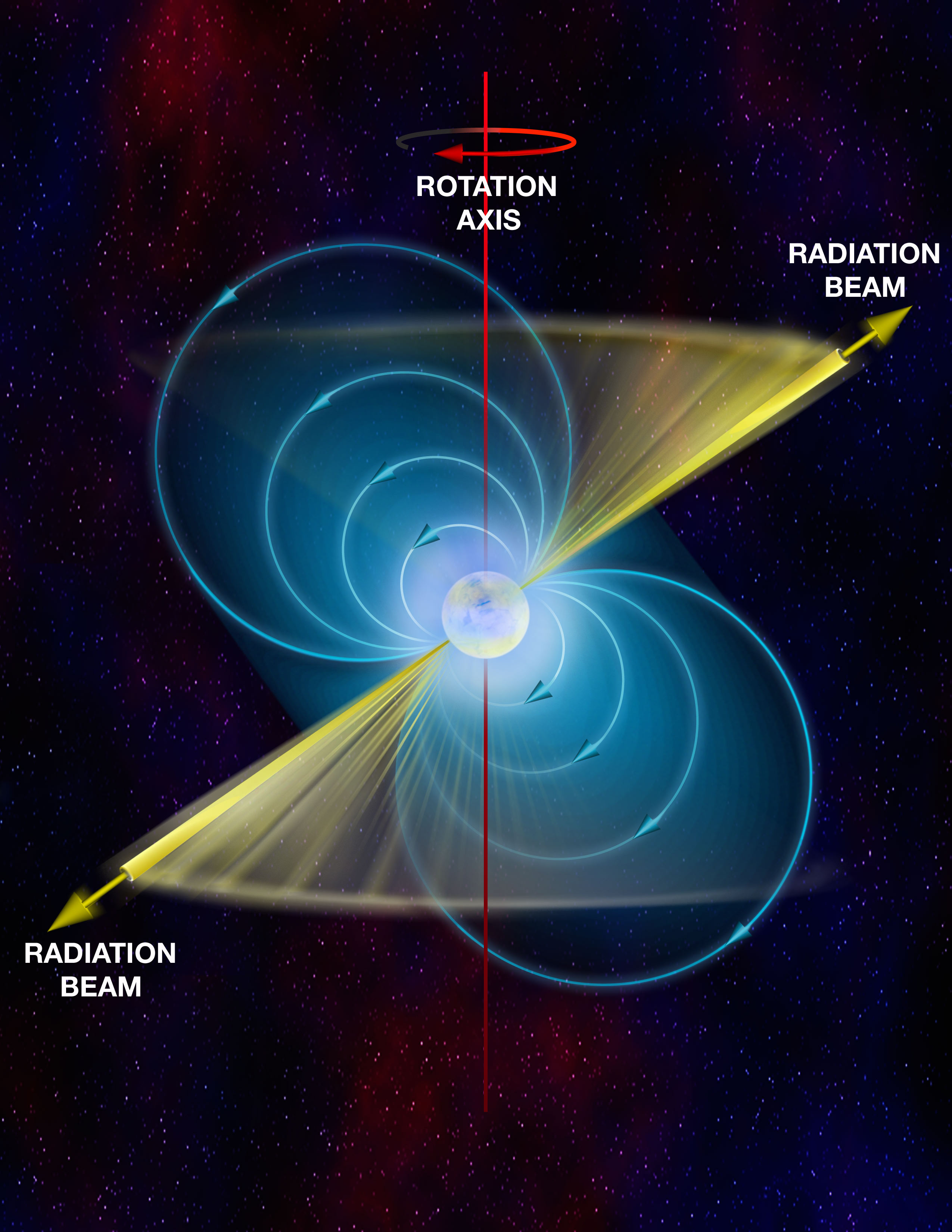
Parts Of A Pulsar National Radio Astronomy Observatory
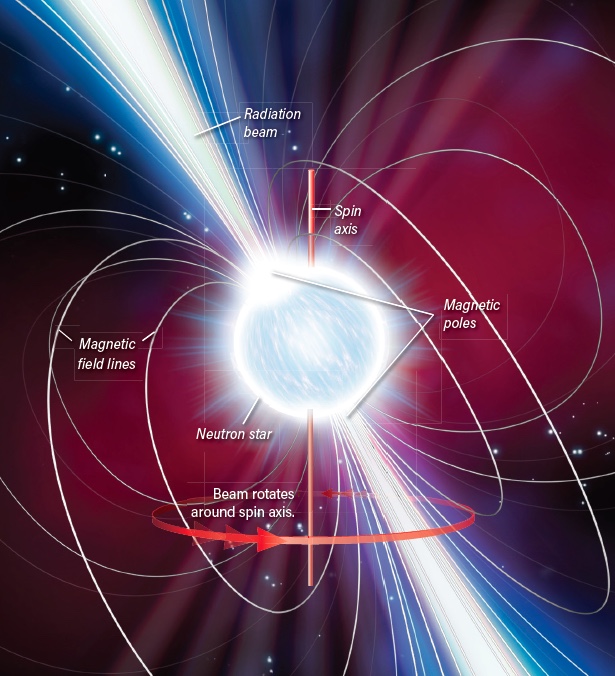
Getting To Know Pulsars The Lighthouses Of The Cosmos Discover Magazine
Comments
Post a Comment